
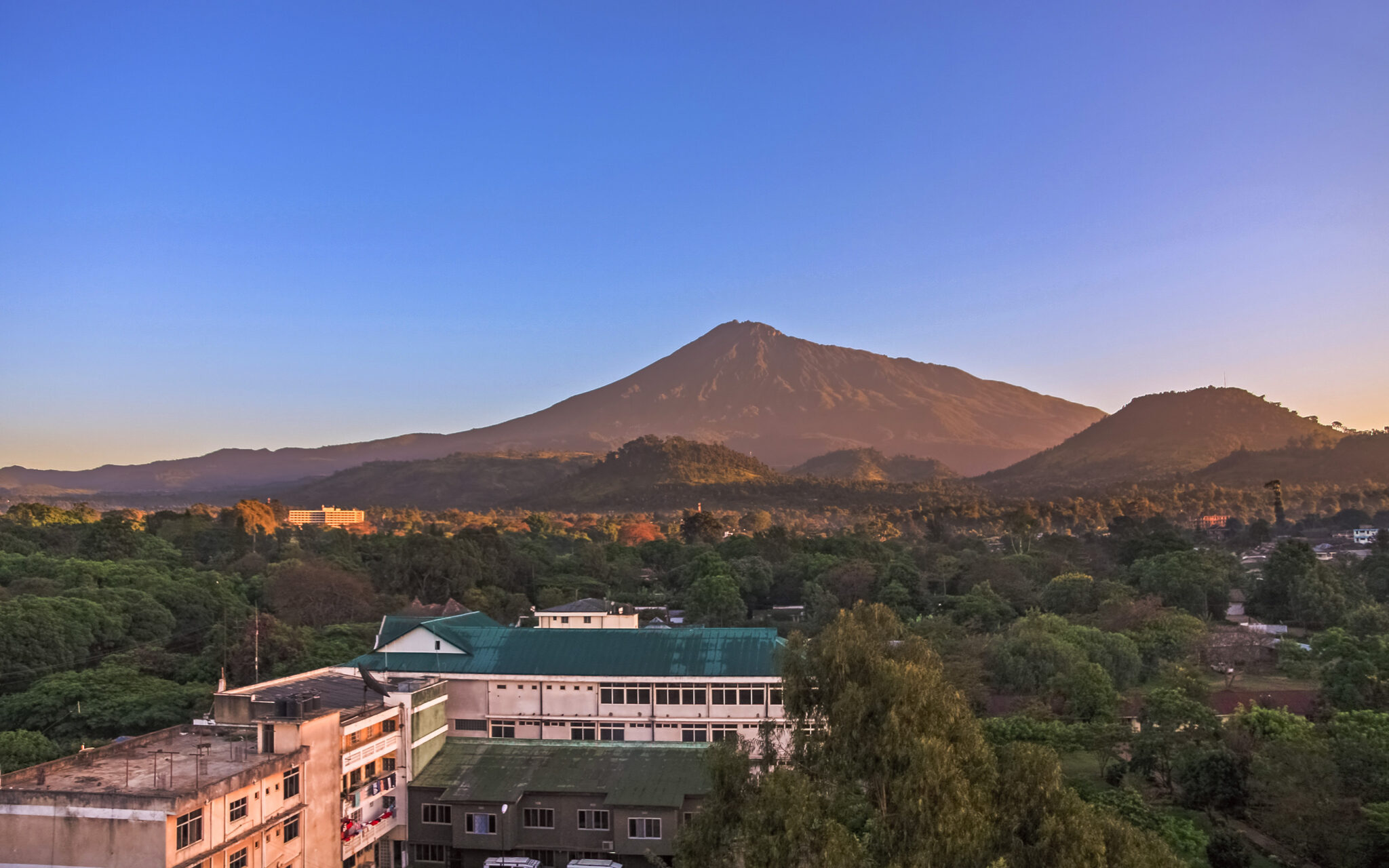
A VOLCANO ABOVE ARUSHA
Mount Meru dominates the skyline around Arusha.
Its present form was shaped by volcanic activity and a massive collapse of part of the mountain, leaving behind a dramatic crater and steep internal cliffs.
From below, Meru often appears green and heavily forested.
Higher up, that softness disappears.
The trail eventually reaches more exposed terrain where the mountain’s volcanic origins become impossible to ignore.
Ridges narrow.
Rock replaces forest.
And the summit begins feeling considerably farther away than it looked from town.
THE TREK BEGINS WITH WILDLIFE
This is where Meru immediately separates itself from most mountain experiences.
The trek begins inside Arusha National Park.
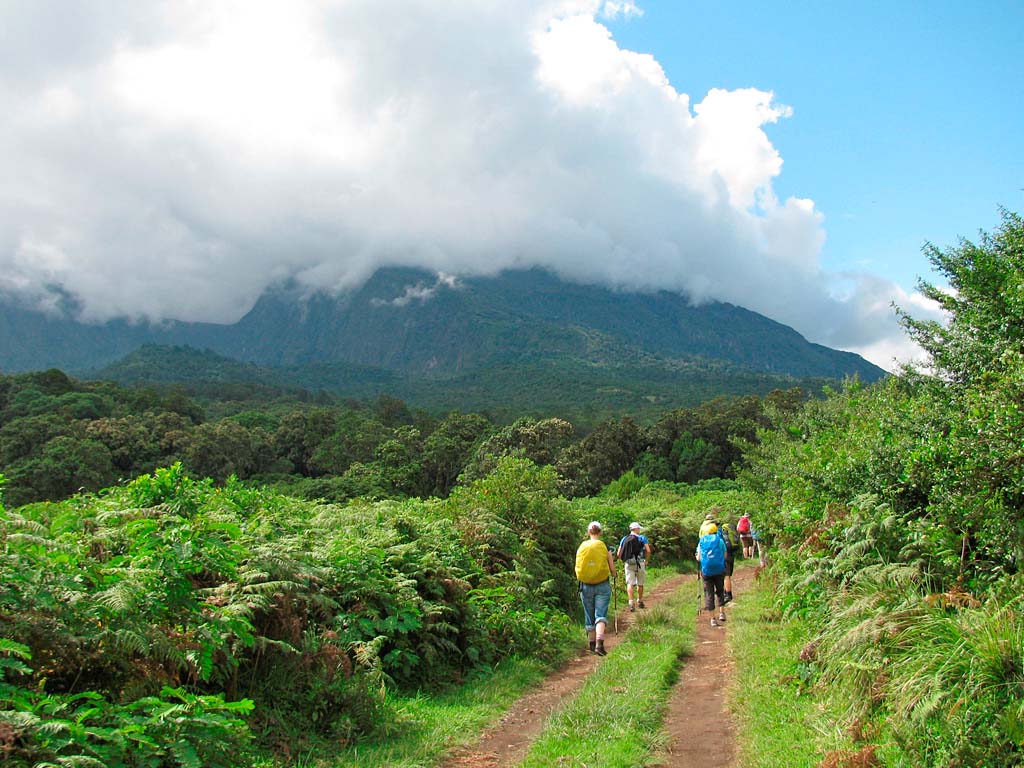
Lower sections of the route pass through habitats occupied by buffalo, giraffes, warthogs, bushbuck, monkeys and numerous bird species. Black-and-white colobus monkeys are particularly characteristic of the park’s forests.
Because of the presence of large wildlife, trekkers are accompanied by an armed park ranger as required.
One minute you’re starting a mountain expedition.
The next, you’re watching giraffes.
It’s a wonderfully Tanzanian way to begin climbing.
FROM FOREST TO OPEN MOUNTAIN
As the trail gains altitude, Mount Meru changes character.
The rich forest of the lower slopes gradually gives way to heath and moorland vegetation. Trees become smaller and views begin opening across Arusha National Park and the surrounding landscape.
Higher still, the terrain becomes increasingly exposed.
This transition is one of the pleasures of climbing Meru.
You don’t simply move upward.
You move through entire environments.
By the time you reach the upper mountain, the green world where you started feels surprisingly distant.
THE SUMMIT RIDGE
WHERE MERU SHOWS ITS TEETH.
The final climb toward Socialist Peak, Mount Meru’s highest point, is the mountain’s defining section.
Summit attempts normally begin before dawn.
The route climbs through darkness toward the crater rim before following exposed volcanic terrain toward the summit.
This is not simply a long uphill walk.
The narrow ridge, steep sections, altitude and darkness create a much more adventurous atmosphere than many travellers expect from Tanzania’s second-highest mountain.
Then daylight arrives.
The crater opens beneath you.
And if the clouds allow it, Kilimanjaro appears across the plains.
For a few minutes, Tanzania’s highest mountain becomes part of Meru’s view.
4,566 METRES IS STILL HIGH ALTITUDE
Mount Meru is lower than Kilimanjaro.
That does not make altitude irrelevant.
At 4,566 metres, climbers can still experience the effects of reduced oxygen, particularly as the trek gains elevation quickly.
Good pacing, hydration, rest and honest communication with guides remain important throughout the climb.
Meru demands respect.
It simply asks for it in fewer days.
HOW LONG DOES MOUNT MERU TAKE?
The climb is commonly completed over three or four days, with the four-day itinerary offering a more relaxed pace and additional time on the mountain.
4 DAYS · 4,566 M · WILDLIFE TO SUMMIT
The shorter option can remain available on request for experienced and appropriately prepared trekkers.
THE WILDPACK MERU ROUTE
DAY 01 / MOMELLA GATE → MIRIAKAMBA HUT
The adventure begins inside Arusha National Park, where the lower trail passes through wildlife country and forest before climbing toward Miriakamba Hut.
OVERNIGHT: Miriakamba Hut
DAY 02 / MIRIAKAMBA HUT → SADDLE HUT
Continue upward through changing vegetation toward Saddle Hut, positioned between Meru’s main summit and Little Meru.
OVERNIGHT: Saddle Hut
DAY 03 / SADDLE HUT → SOCIALIST PEAK → MIRIAKAMBA HUT
Begin during the night for the summit attempt, following the crater rim toward Socialist Peak at 4,566 m before descending back toward Miriakamba.
OVERNIGHT: Miriakamba Hut
DAY 04 / MIRIAKAMBA HUT → MOMELLA GATE
Descend through the forest and return to Momella Gate, completing the journey where wildlife and mountain first met.
END OF TREK
WHEN IS THE BEST TIME TO CLIMB MOUNT MERU?
Mount Meru can be climbed during much of the year, but the generally drier periods tend to provide more comfortable trail conditions and better opportunities for clear mountain views.
Rain can make forest trails muddy and upper sections more challenging, while cloud frequently forms around the mountain regardless of season.
For summit views, luck remains part of the expedition.
Mountains aren’t particularly interested in photography schedules.
MERU + KILIMANJARO
For travellers with enough time, this could become a distinctive Wildpack adventure.
TWO MOUNTAINS. ONE JOURNEY.
4-Day Mount Meru
↓
Rest / Recovery
↓
8-Day Lemosho Kilimanjaro
Meru provides valuable altitude exposure.
Kilimanjaro takes you higher.
Together, they create something far more interesting than treating Meru as a practice hike.
MOUNT MERU WITH WILDPACK
Come because Kilimanjaro made you curious.
Then forget about Kilimanjaro for a while.
Walk through forest where buffalo still roam.
Sleep beneath the summit.
Wake in darkness.
Follow a volcanic ridge into sunrise.
Stand at 4,566 metres with northern Tanzania spreading below you.
Then look east.
If the clouds cooperate, Africa’s highest mountain will be standing there too.
Not above you.
Across from you.