
THE LAND OF BAOBABS AND ELEPHANTS
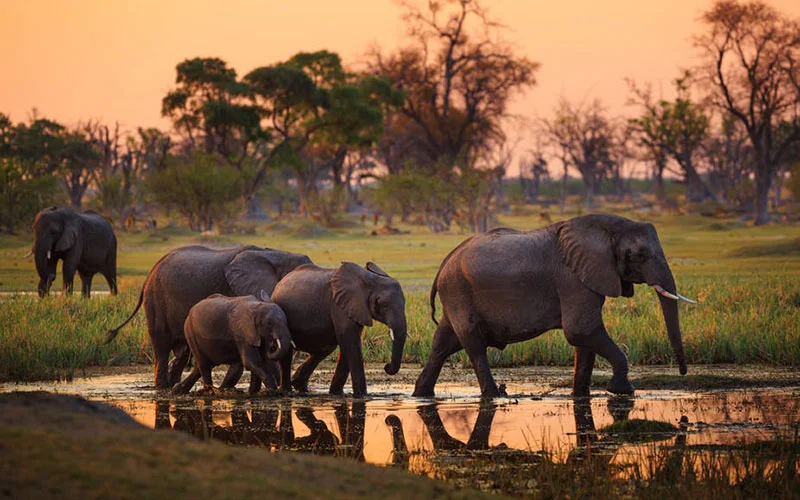
Few landscapes announce themselves as clearly as Tarangire. Massive baobab trees rise above golden grasslands, their thick trunks and twisted branches giving parts of the park an almost prehistoric appearance. Between them move some of Tarangire’s most famous residents: elephants. Family groups can often be seen feeding through woodland, digging for moisture, crossing dusty roads or gathering near water. While elephants occur throughout Tanzania’s northern circuit, Tarangire offers a particularly memorable setting in which to watch them, especially when entire herds emerge beneath the silhouettes of ancient baobabs.
THE RIVER THAT KEEPS THE WILD CLOSE
The Tarangire River is the park’s lifeline. During the wetter months, wildlife can disperse across a much wider ecosystem, but as the landscape dries, permanent water becomes increasingly important. Animals are drawn toward the river and remaining wetlands, concentrating wildlife within the park. Zebra, wildebeest, buffalo, giraffes, impala and elephants gather around reliable water, while predators take advantage of the increased activity. This seasonal rhythm is central to understanding Tarangire. The park you experience during the green season can feel dramatically different from the dusty, wildlife-rich landscape of the later dry months.
WILDLIFE BEYOND THE ELEPHANTS
Elephants may steal the headlines, but Tarangire supports an impressive variety of wildlife. Lions are regularly encountered, while leopards and cheetahs are present but naturally more elusive. Giraffes move elegantly through the woodland, buffalo gather in substantial herds and zebra and wildebeest become particularly numerous during favourable seasonal conditions. Tarangire is also known for species that can be harder to encounter elsewhere on the standard northern circuit, including fringe-eared oryx and greater kudu in suitable areas. Birdlife is exceptional too, with the park’s mixture of woodland, grassland, riverine habitat and seasonal swamps supporting a remarkable diversity of species.
A PARK THAT CHANGES WITH THE SEASONS
Tarangire has two very different personalities. During the dry season, broadly from June through October, vegetation thins, the landscape becomes dusty and wildlife increasingly concentrates around permanent water. This is the Tarangire many travellers have seen in photographs: elephants beneath baobabs, animals gathering around the river and golden grass glowing in the afternoon light. During the greener months, the park transforms. Grasslands become lush, seasonal wetlands expand, birdlife flourishes and the landscape takes on a completely different beauty. Wildlife may be more dispersed, but the park can feel quieter, greener and wonderfully atmospheric.
WHEN IS THE BEST TIME TO VISIT TARANGIRE?
For travellers primarily interested in concentrated wildlife viewing, the dry months from roughly June through October are particularly rewarding. As water becomes scarce outside the park, the Tarangire River and surrounding wetlands attract increasing numbers of animals. The green season, however, should not be dismissed. From around November onward, seasonal rains transform the scenery, migrant birds arrive and visitor numbers can be lower. The heavier rains generally occur around March through May. Ultimately, the best time depends on whether your priority is maximum wildlife concentration or lush landscapes, birdlife and a quieter atmosphere.
HOW LONG SHOULD YOU SPEND IN TARANGIRE?
Tarangire can be visited as a full-day safari from Arusha, but spending at least one night in or near the park creates a much better experience. Two nights allow you to move beyond the busiest areas, enjoy early and late game drives and explore the park at a more natural pace. On longer northern circuit itineraries, Tarangire works beautifully as either the opening chapter before Ngorongoro and Serengeti or the final wild stop before returning to Arusha.
TARANGIRE WITH WILDPACK
Tarangire rewards patience. Don’t drive past the elephants because you’ve already photographed elephants somewhere else. Stop. Watch the calves disappear beneath the adults. Watch a herd move silently between baobabs. Wait beside the river and see what arrives next. Tarangire isn’t about chasing one famous sight. Its magic is in the landscape, the seasonal rhythm and those moments when something enormous walks quietly into view.